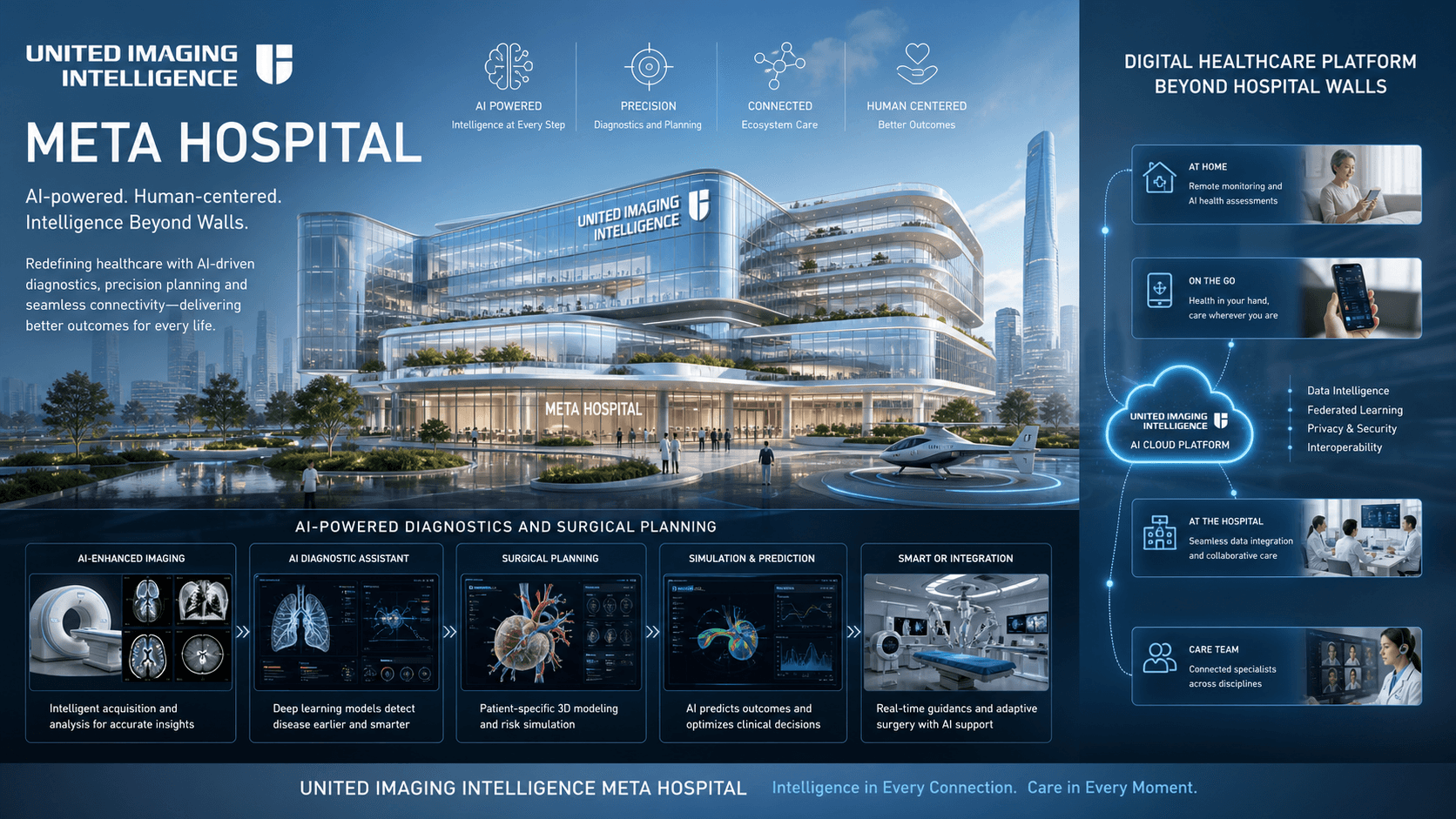
United Imaging Intelligence Unveils Meta Hospital Strategy to Extend Care Beyond Physical Walls
- United Imaging Intelligence's Meta Hospital strategy uses multi-modal AI agents, digital twins, and connected devices to extend care beyond physical hospital walls.
- The Yuan Doctor agent autonomously completed CT analysis, staging, 3D reconstruction, and surgical planning in a live liver cancer demonstration.
- Scaled deployment faces three critical gates covering regulatory compliance, clinical accuracy, and agent-device coordination as medical robotics continue to evolve.
The strategy centres on the Yuan Doctor, a central intelligent agent that coordinates specialised sub-agents across the full hospital workflow, integrating diagnostics, surgical planning, equipment orchestration, and post-discharge monitoring into a unified intelligence network.
Yuan Doctor demonstrates three capability layers: cognitive ability powered by the Yuanzhi multi-modal large model and a dynamically updated medical knowledge base; orchestration ability to dispatch specialised agents, imaging analysis tools, and surgical robots simultaneously; and execution ability connecting AI cognition to physical outcomes through digital twins and medical device interoperability.
A liver cancer demonstration showed Yuan Doctor autonomously completing CT analysis, CNLC staging, Child-Pugh classification, liver 3D reconstruction with precise vascular identification, and generating two surgical plans within minutes.
United Imaging Intelligence co-CEO Zhou Xiang described the strategy as addressing three bottlenecks of traditional hospitals: time, space, and human resource constraints.
The Meta Hospital does not replace doctors or physical hospitals but extends their capability through digital augmentation, enabling continuous care across hospital, home, and daily life environments through medical-grade wearable devices, proactive health monitoring, and early warning systems.
Industry observers identified three critical gates for scaled deployment: a compliance gate requiring alignment with medical regulations and ethical oversight; a professional gate demanding prevention of misdiagnosis, missed diagnosis, and model hallucination; and an execution gate requiring improved agent-device coordination as medical robotics evolve.
United Imaging Intelligence is part of the United Imaging group, a major Chinese medical imaging equipment manufacturer, giving it a distinct advantage in bridging AI software with physical medical devices across the full diagnostic and treatment chain.
Yifangda Capital investment committee chair Wang Hao identified three core investment themes shaping the sector: medical vertical large models and multi-modal agents, AI-native medical information systems, and AI-native medical hardware.
Wang noted that companies combining complete clinical scenarios, compliance capabilities, scaled clinical deployment, and full-industry-chain ecosystem integration are best positioned to lead the shift from AI-assisted tools to AI-orchestrated healthcare systems.
The broader healthcare AI landscape is moving away from single-point tools in medical imaging or records management toward platform-level integration, with the Meta Hospital strategy positioning United Imaging Intelligence at the centre of that transition.