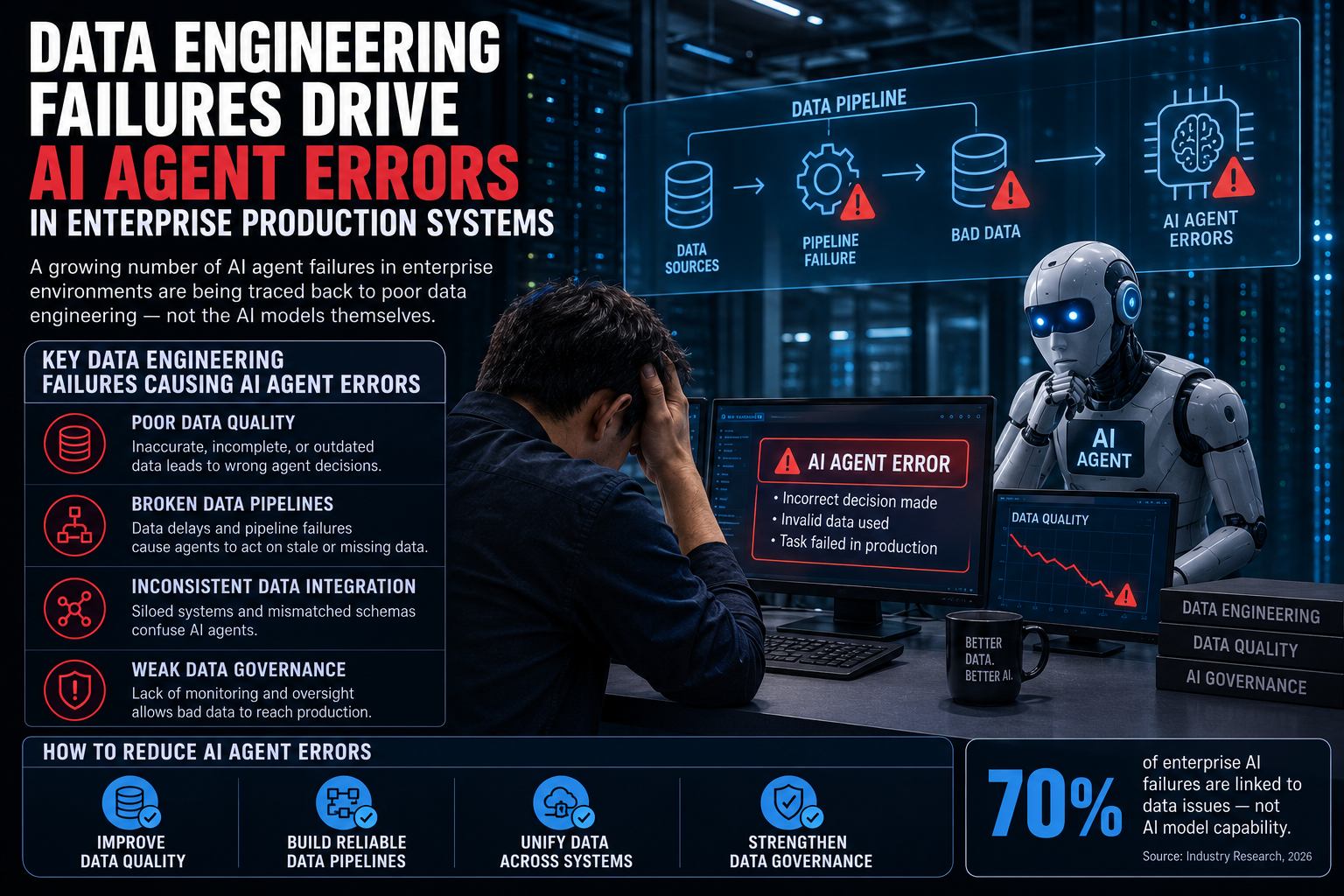
Data Engineering Failures Drive AI Agent Errors in Enterprise Production Systems
- Artificial intelligence agent errors stem from stale or unvalidated data pipelines rather than model or prompt flaws.
- Context layer tools fail to resolve errors because underlying knowledge stores lack automated correctness and freshness checks.
- Enterprise data observability relies on enforcing correctness, freshness, consistency, and lineage across data engineering layers.
Systems perform accurately upon initial deployment, but accuracy deteriorates within months as real-world information changes without updating the underlying knowledge store. Standard retrieval pipelines evaluate relevance or availability rather than correctness, allowing stale documents and incomplete records to pass through cleanly.
Organizations frequently misdiagnose these failures by attempting to swap models, adjust prompts, or purchase better context layers. Technology companies like Amazon Web Services and Snowflake have introduced context and logic management features, but these solutions sit above the root data engineering issues.
Data observability provides the required validation through four specific dimensions:
Correctness ensures records conform to expected shapes, field types, and ranges using automated validation tools like Great Expectations and Soda.
Freshness tracks update times against individual source service level agreements rather than blanket thresholds.
Consistency cross-checks stored data across destinations to catch conflicting facts before systems disagree.
Lineage traces outputs back through every transformation to original sources.
Technology firms have previously implemented these principles at scale. Uber created a Unified Data Quality platform supporting over 2,000 datasets to detect around 90% of data quality incidents before reaching downstream consumers. Netflix built a company-wide data lineage system mapping dependencies across messaging topics, machine learning models, and warehouse tables.
Identity verification firm Socure utilized a write-audit-publish pattern to isolate client data in staging until validation passed. Implementing schema checks, source-specific freshness thresholds, and lineage tracking improved downstream accuracy for reporting, machine learning models, and artificial intelligence retrieval.