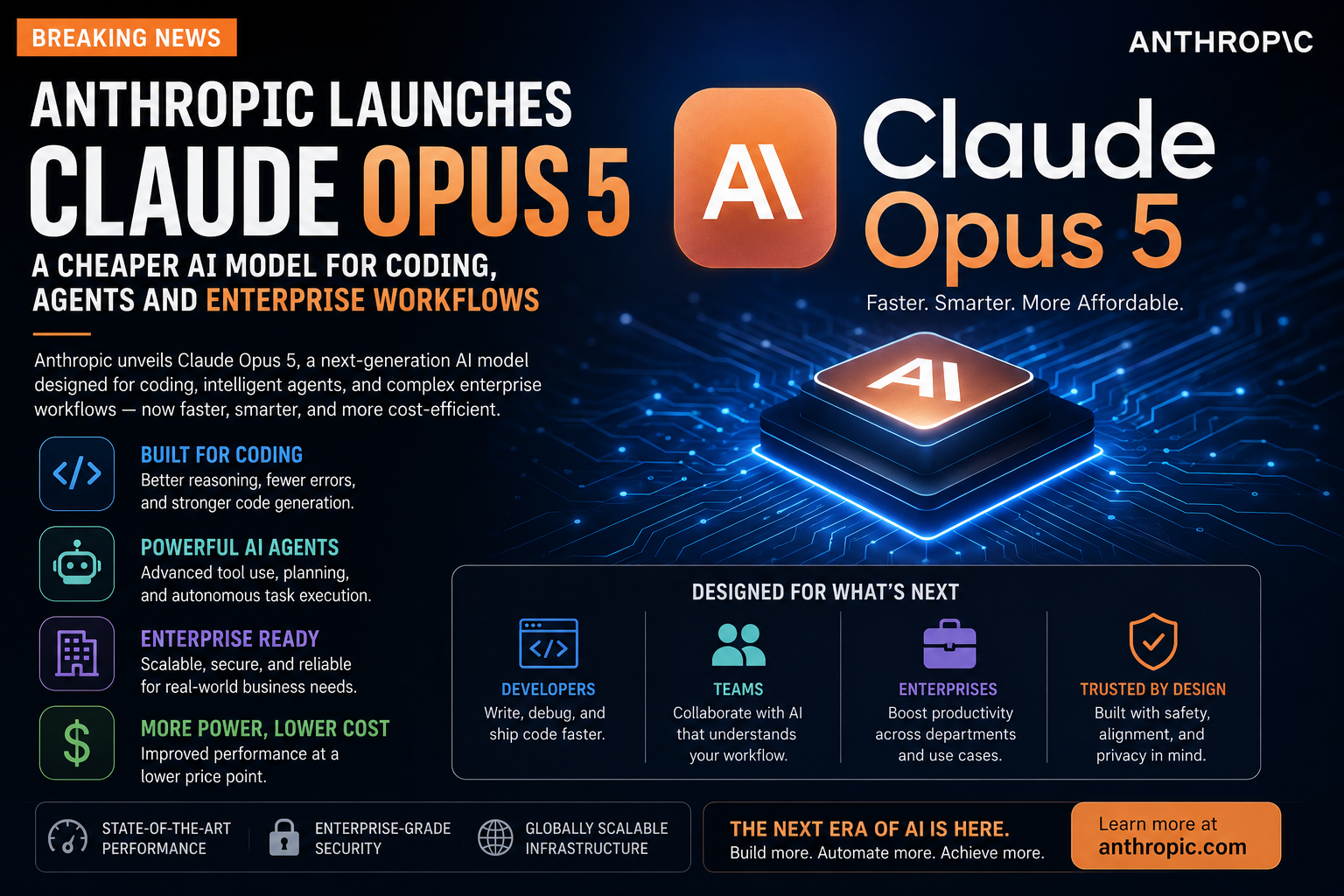
Anthropic Releases Claude Opus 5 Model for Daily Enterprise Workflows
- Anthropic launched Claude Opus 5 to deliver near-top intelligence at half the cost of Fable 5 for everyday enterprise tasks.
- The model demonstrated benchmark gains in terminal coding and novel problem-solving while reducing token usage and processing times.
- Pricing remains at USD 5 per million input tokens and USD 25 per million output tokens, featuring optional Fast mode and safety fallbacks.
Anthropic positions Opus 5 for bounded, complex daily tasks, while reserving Fable 5 for long-horizon autonomous projects lasting days. Sonnet 5 handles high-volume tasks where speed dictates deployment, and Haiku 4.5 delivers subagents and instant answers.
On the agentic terminal coding benchmark Frontier-Bench v0.1, Opus 5 scored 43.3%, surpassing the 18.7% score of Opus 4.8 and the 33.7% score of Fable 5. The model also scored three times higher than the next best model on the ARC-AGI 3 novel problem-solving evaluation.
Performance gains come with specific capability limits, as Opus 5 trails Mythos 5 on cybersecurity tasks and biology research. An OpenAI family model also maintains a lead on one agentic coding benchmark.
To save costs, Opus 5 features an adjustable effort setting that lets users trade intelligence for speed and reduced token usage. Early testers like Harvey reported the model achieved similar performance to Opus 4.8 maximum reasoning while generating 26% fewer tokens on average.
Fundamental Research Lab found the model averaged nine percentage points higher accuracy on financial modeling tasks while using one-third fewer turns and 60% less time. On AutomationBench, Zapier Chief Executive Wade Foster noted Opus 5 reached a 100% pass rate without increasing token spend.
Cognition Chief Executive Scott Wu stated that Opus 5 approaches Fable level performance at half the cost on Frontier Code 1.1, showing strength in debugging.
Anthropic intentionally avoided training Opus 5 on cyber exploitation tasks. On the OSS-Fuzz evaluation, Opus 5 identified vulnerabilities at a 79.4% rate, near the 80% mark of Mythos 5, but developed exploits in only four challenges compared to 13 by Mythos 5.
When safety classifiers trigger, requests in Claude.ai, Claude Code, and Claude Cowork automatically fall back to Opus 4.8. An Anthropic spokesperson noted that falling back to a lower capability model reduces the overall risk of harmful use.
For scientific research, Opus 5 scored 10.2 percentage points higher than Opus 4.8 on internal chemistry benchmarks. Mythos 5 remains stronger for open-ended scientific tasks like autonomous drug design campaigns.
Anthropic held roughly 40% of the enterprise large language model market by usage in late 2025, with Claude Code generating about USD 1,000,000,000 in annualized revenue. Contrary Research analysis indicates Anthropic annualized revenue climbed from about USD 1,000,000,000 in late 2024 to a projected USD 9,000,000,000 in 2025.
Internal revenue targets reach USD 20,000,000,000 to USD 26,000,000,000 for 2026. A funding round valued Anthropic at roughly USD 380,000,000,000, backed by a USD 30,000,000,000 Azure compute deal alongside Google Cloud and Nvidia arrangements.
A judge gave final approval to a USD 1,500,000,000 copyright settlement between Anthropic and book authors. The U.S. government also moved to block foreign access to the most advanced models of Anthropic.
The release includes a Fast mode operating at 2.5 times default speed for double the base price. Developers can access the model using the identifier claude-opus-5 on the API, which features no data retention requirements for general access.